
 h2>Can Plan B delay your period?
Yes, Plan B One-Step can make your next period arrive early or late. It can also change the flow, making it heavier or lighter than usual, and may cause spotting between now and when your actual period starts.
While a late period is a known side effect of taking emergency contraception, it is important not to assume that every delay is caused by the medication. Stress and other factors can also shift your cycle. If your period does not arrive within a specific timeframe after taking Plan B, pregnancy becomes a possibility that should be ruled out. For detailed instructions on when to test, see the section below.
Why Plan B can change menstrual timing
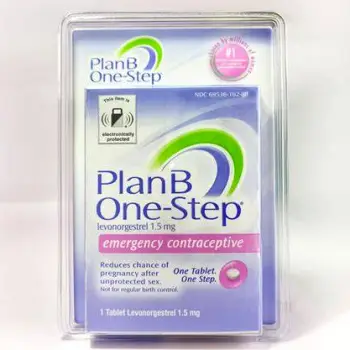
Plan B One-Step contains 1.5 mg of levonorgestrel, a progestin used for emergency contraception after unprotected sex or contraceptive failure. It is designed for single-use situations and does not serve as routine birth control.
The medication works primarily by stopping or delaying the release of an egg from the ovary (ovulation). By interfering with this natural process, Plan B can disrupt your hormonal schedule just enough to shift the timing of your next menstrual period. Because the drug acts on the cycle's key trigger point, the subsequent bleed may not arrive on the exact date you predicted. Plan B is not effective for terminating an existing pregnancy; it only prevents ovulation or fertilization if a pregnancy has not yet been established.
Plan B and Menstrual Cycles Check
How late can your period be after Plan B?
According to US labeling, your next period should generally occur at its expected time or within one week of that date. If your period is more than one week late, you should consider the possibility of pregnancy rather than attributing the delay solely to Plan B.
Clinical data provides context for this variability. In a safety study of 1,359 women who received Plan B One-Step, 4.5% experienced menses more than seven days later than expected. This figure represents a frequency observed in a specific trial group and is not a prediction for any individual person. While some users may experience slightly longer delays, there is no evidence to suggest that Plan B commonly disrupts cycles for multiple months or causes permanent changes to menstrual regularity. Most cycle irregularities resolve quickly after the medication leaves your system.
Spotting or a period: how to interpret bleeding after Plan B
It is common to experience spotting-a light flow that may appear pink, brown, or red-within a few days of taking Plan B. This spotting is distinct from your menstrual period and should not be confused with it.

Your actual next period might arrive earlier or later than planned and could be heavier or lighter than your typical flow. Neither the presence nor absence of bleeding, nor the specific characteristics of that bleeding (such as being light or heavy), proves whether Plan B worked or failed. Spotting can occur even if the contraception was successful, and a lack of spotting does not guarantee failure. Only a pregnancy test can provide accurate confirmation of success.
When to take a pregnancy test
You should take a pregnancy test if your expected period is more than one week late. This is the specific threshold outlined in US labeling for when emergency contraception may have been ineffective.
Do not rely on symptoms like cramping, breast tenderness, or spotting to determine whether you are pregnant. These signs can be caused by Plan B itself or by premenstrual syndrome. Because hormonal fluctuations from the medication can mimic early pregnancy symptoms, a test is the only reliable way to know your status once the one-week window has passed. Follow up with a healthcare professional if the test is positive or if you remain uncertain about your cycle changes.
What to do while waiting for your period
While you wait for your next period, keep track of the date it was originally expected and note any bleeding patterns you experience. Distinguishing between light spotting and what looks like your usual menstrual flow can help clarify your situation when it is time to test.
A critical point to remember is that Plan B does not provide ongoing protection against pregnancy. It only addresses the single instance of unprotected sex that occurred before taking the pill. If you have sexual intercourse again after taking Plan B, you are still at risk of becoming pregnant. Because fertility can return rapidly after taking levonorgestrel emergency contraception, you should continue or begin a routine contraceptive method promptly to prevent future unintended pregnancies.
When to contact a healthcare professional
Contact a healthcare provider in two primary scenarios following Plan B use. First, if your period is more than one week late and you have not yet taken a pregnancy test, consult a professional for guidance and testing. Second, if you experience severe lower abdominal pain three to five weeks after taking Plan B, seek medical attention immediately.
Severe abdominal pain in this timeframe requires evaluation for possible ectopic pregnancy-a serious condition where a fertilized egg implants outside the uterus. While this pain is not proof of ectopic pregnancy, it is a significant warning sign that needs prompt medical assessment. If you receive a positive pregnancy test result, professional follow-up is necessary to discuss next steps and ensure appropriate care.
Plan B One-Step can make your next period arrive early or late, change how heavy or light it is, and cause spotting. It works mainly by stopping or delaying ovulation and is not effective for terminating an existing pregnancy. Most cycle irregularities resolve quickly after the medication leaves your system, and there is no evidence that Plan B commonly disrupts cycles for multiple months or causes permanent changes to menstrual regularity.
According to US labeling, your next period should generally occur at its expected time or within one week of that date. If your period is more than one week late, you should consider the possibility of pregnancy and take a pregnancy test. Spotting, lack of spotting, cramping, breast tenderness, and other symptoms cannot confirm whether Plan B worked or failed, because the medication or premenstrual syndrome can cause similar signs. Only a pregnancy test can provide accurate confirmation; follow up with a healthcare professional if the test is positive or if you remain uncertain.
Plan B does not provide ongoing protection against pregnancy. If you have sex again after taking it, you are still at risk, and fertility can return rapidly, so continue or begin a routine contraceptive method promptly. Contact a healthcare professional if your period is more than one week late and you have not taken a pregnancy test, or if you experience severe lower abdominal pain three to five weeks after taking Plan B. Severe pain in this timeframe requires immediate medical attention to evaluate for possible ectopic pregnancy.
Source organization: American College of Obstetricians and Gynecologists
Source organization: NHS
Source organization: Centers for Disease Control and Prevention
Questions & comments
Please do not include passwords, medical record numbers, insurance information, financial information, precise addresses, or other confidential or directly identifying information in your message.